Skippy Lane

Remembering Skippy Lane

by Katherine Kirkpatrick

Author’s Note: I was asked to write a piece for a friend’s memorial gathering in November 2004. Other friends asked me to include the memoir on my web site, because it tells about the writing of my first novel Keeping the Good Light. When I wrote the book, I was living on City Island, in the New York City borough of the Bronx.

One day, as I was riding my bicycle down City Island Avenue, balancing my groceries on my handlebars, a car followed me. A heavyset, older man with cropped, white hair rolled down his window. In a gruff but friendly voice he called out, “Want a ride?”

That was my first memory of Skippy Lane. It was the summer of 1990, just after I’d moved to City Island, when I was in my mid 20s. I didn’t give Skippy my groceries to transport that day. But soon after that we became friends. Everywhere I’d go on the island I’d see him.

Why is it that on City Island, the home of more than 5,000 people, it’s always the same 50 you keep running into? That’s one of the great joys of living on the island. You can form friendships and a sense of community almost instantly. The only requirement is that you remain open to having new experiences. Then all those wonderfully unique individuals, City Island “clam diggers”—such as Captain Fred “Skippy” Lane, retired captain of oil tankers—welcome you.

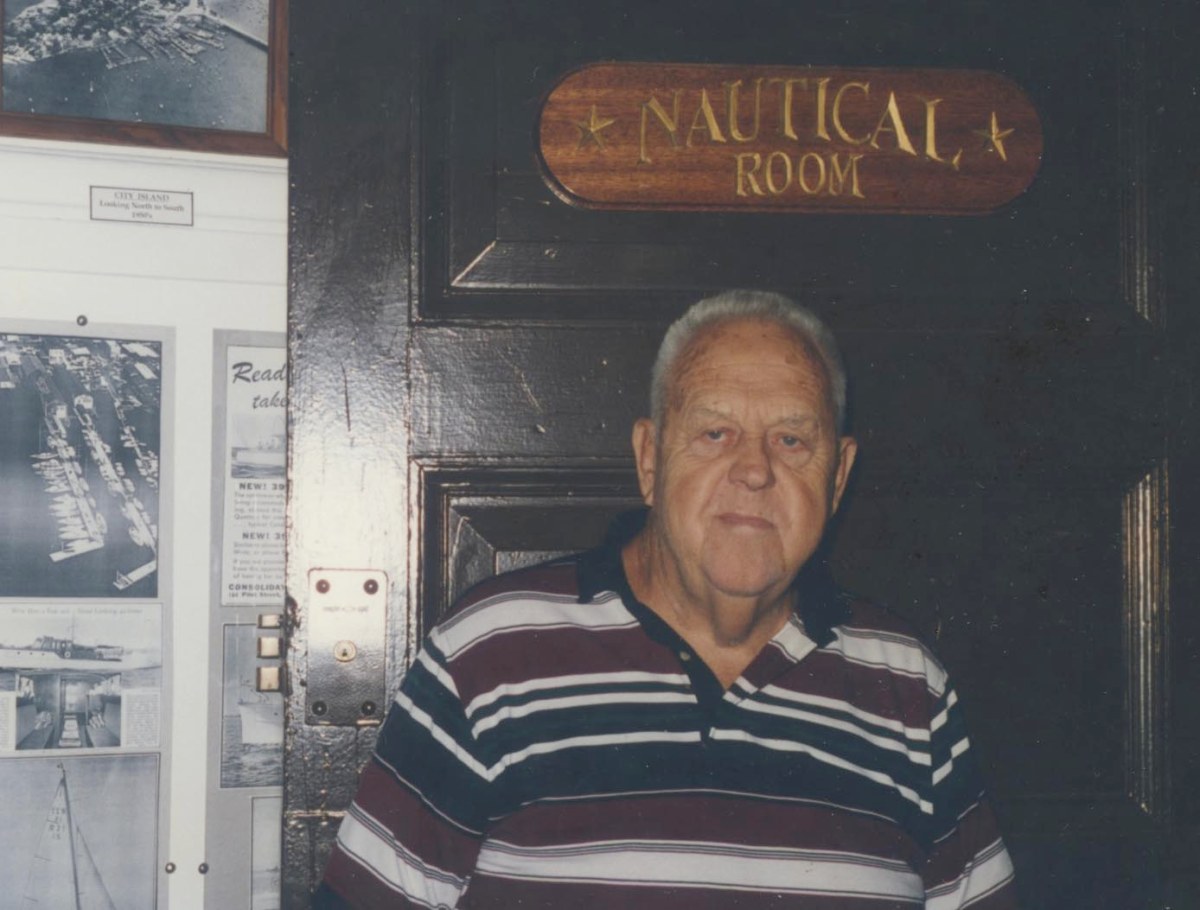
Skippy liked nothing better than acting as tour guide to newcomers. He loved City Island as I grew to love it, too, and he was proud of it. I’m wondering how many hundreds of people he showed around the island in his lifetime. If I ever had visitors, I brought them over to Skippy’s house to see his living room of nautical treasures. Then Skippy would take us on a drive, cruising at ten miles an hour, with cars honking at us from behind.

Here’s the house where he was born, he’d say. Here’s his old school, now condos. Here’s the former location of an old shipyard, where he’d go when he was supposed to be at school. Here’s a street that was under water during the hurricane of 1938. The tour usually had a few moments of real excitement: Vicious guard dogs barked at us as we pulled up to the white mansion owned by, according to Skippy, the mafia.

Skippy enjoyed showing the places in Pelham Bay Park where gangsters buried their victims. It was often Skippy himself who would tip off the police; Skippy had an unusually keen sense of smell and, from his 40 years at sea, knew the scent of a corpse. Besides, who else but Skippy would be poking about Pelham Bay Park at 5 in the morning? His daily, early-morning routine included dropping off a newspaper and coffee to the park ranger.

It was Skippy who first pointed out to me that gulls always face into the wind. It was Skippy who took me to see a three-hundred-year-old tree on the golf course off Shore Road. Skippy possessed sharp powers of observation and an eye for beauty. He had an excellent memory, a love of history, especially maritime history, and liked to read. Through him I learned a great deal, especially since he repeated himself so much. If I missed some of the details in the first go-around of a story, I’d be sure to hear them again.

Creating a book together gave our friendship focus. Skippy referred to Keeping the Good Light as “our book” and that’s accurate. Though I did all the writing, Skippy provided much of the historical background and many ideas that helped to shape the plot. I wanted to write a historical novel set on City Island but couldn’t decide which time period. Skippy chose the year 1903. That way, we could include one of Skippy’s favorite America Cup winners, the Reliance. Skippy wanted to make sure I presented City Island at its very best, in its heyday as a yacht-building center.

Schooner

In the book, one of the main characters dies. In an early draft, the death occurred on the Reliance. Skippy was incensed. “You’re maligning the reputation of a great sailing vessel,” he said. “All right,” I replied. “Then help me come up with the details for another tragedy. We need a shipwreck.” I’m so glad I asked Skippy that request. It prompted him to tell me about the time he’d witnessed the wrecking of a schooner on a reef near City Island as a young boy. We used this dramatic story, changing the real-life names.

Skippy himself made a cameo appearance in the novel as Captain Elijah Gildersleeve. My main character, Eliza, who lives at Stepping Stones lighthouse, writes a message in a bottle and throws it out to sea. Captain Gildersleeve finds the bottle. I wrote this episode because Skippy had a hobby of releasing drift bottles during his voyages around the world.

Several times during the writing of the book, Skippy took me out to Stepping Stones lighthouse in his Rhodes 19. Because there was no place to dock, we’d circle around the lighthouse. To see the lighthouse up close, I’d swim to it.

One time I climbed up the ladder of the lighthouse and found the padlock on the front door unlocked. What luck! I crept inside. I flipped a switch and was surprised when a light turned on. I climbed up the spiral stairs to the very top of the tower and waved at Skippy. I was having so much fun exploring that I didn’t return to the boat for fifteen minutes. Tears ran down Skippy’s face when he saw me. “I didn’t know what happened to you. I thought you were electrocuted!”

Another time Skippy taught me to row. There’s a scene in the book in which Eliza rows from the lighthouse to City Island. Skippy said I’d gotten my details all wrong. So he stood on the beach of Horton Street shouting orders at me as I reenacted the drama.

Skippy read every draft of Keeping the Good Light. Unfortunately, Skippy tended to call me up on the phone every fifteen minutes to give his critique. He’d go on a sort of tirade, insisting, for example, that I take out the word “boat” and use “vessel” or “yacht” instead. “It’s an insult to call a great vessel a boat,” he’d say. He even caught grammatical errors and misspellings that a professional copy editor failed to detect. Remarkable for someone with an 8th-grade education.

One of my favorite memories of Skippy was at my 30th birthday party in April of 1994. About a hundred people came. Skippy sat in the middle of a couch, in the center of all the action, telling stories. It was a happy time because I’d just learned that Delacorte Press was going to publish my novel. My sister came to the party from Virginia. She decorated a cake with a picture of Stepping Stones lighthouse.

Rowboat

Authors rarely meet their jacket artists. But in my case, the jacket artist for Keeping the Good Light visited me on City Island. He wanted to take pictures of someone posing in a rowboat. Skippy provided his turn-of-the-century pram and even gave it a new coat of paint for the occasion. I sat in the boat wearing a period dress. Later, it delighted Skippy to see his pram on the cover of the novel, but he demanded to know why I didn’t appear in the illustration.

Seeing Keeping the Good Light published was, I believe, a highpoint of Skippy’s life as well as my own. Over the years, he read drafts of my next few novels, too. As Skippy’s health declined, he left his home less often, and our excursions became less frequent. I still stopped by his house regularly, though, until I married and moved from the island to Seattle in 1999.

The last time I saw Skippy in person was in June of 2001. My visit to City Island was constrained because my husband and I had our twin baby girls with us. Skippy wasn’t able to come to my friend’s gathering because, by that time, he could hardly walk and no longer drove a car. When the party was over I persuaded my husband to let us spend a little more time on the island so I could see Skippy. We drove to his house where he was waiting on his porch. I carried my babies in their car seats up to Skippy so he could see their faces.

When I learned of Skippy’s death this fall, I’d just been getting ready to send a copy of my fifth published book to him at his nursing home. He would have been proud.

I often think of Skippy and remember the nine years I spent on City Island with great fondness. I never loved a place as much as I loved City Island. Skippy and I shared that same feeling for the island.

I’ll close with one of Skippy’s phrases: “Old sailors never die, they just lose mooring.” Where has Skippy gone now? I like to think he is off somewhere, having more adventures around the world, or in the universe at large.